Industrial chillers can be classified in various ways, but the most important classification is based on the condenser heat dissipation method, dividing them into two main categories: air-cooled chillers and water-cooled chillers.
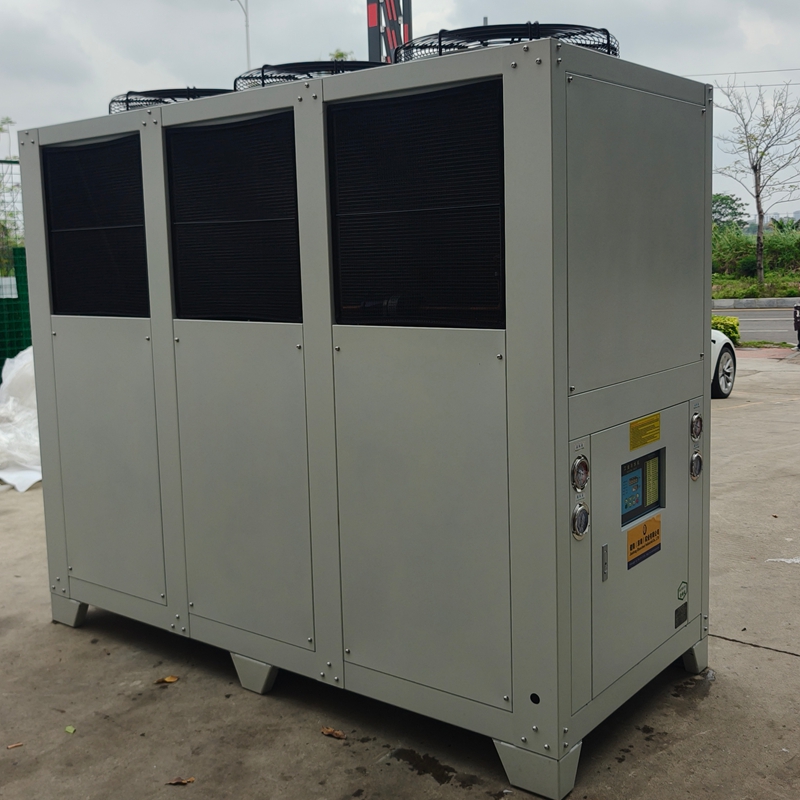
1. Air-cooled Chillers and Water-cooled Chillers
1.1 Air-cooled Chillers: These use a built-in fan and finned radiators to directly dissipate heat into the air.
1.2 Water-cooled Chillers: These require an external cooling tower. Heat is first transferred to the cooling water, and then dissipated into the air by the tower.
1.3 A key comparison of the two main types is as follows:
| Comparison Dimensions | Air-cooled chiller | Water-cooled chiller |
| Heat Dissipation Method | The fan forces air to flow through the finned condenser for cooling | Heat dissipation occurs through the water circulation in the cooling tower. |
| Advantages | 1. Easy installation: No need for a cooling tower, compact structure, and mobility 2. Simple maintenance: No complex water system, low maintenance costs 3. Lower investment: Relatively low initial purchase and installation costs | 1. Higher efficiency: High cooling efficiency, especially suitable for large systems\n 2. Stable performance: Less affected by ambient temperature, more stable operation\n 3. Quiet operation: No large fans, lower noise |
| Disadvantages | 1. Limited efficiency: Cooling efficiency is greatly affected by ambient temperature 2. Environmental impact: Hot air will be discharged into the work area | 1. Complex installation: Requires installation of cooling towers, pumps, and pipes\n 2. Higher investment: Higher initial investment and installation costs\n 3. Complex maintenance: Regular maintenance of waterways is required to prevent scaling and freezing |
| Ideal Scenario | 1. Small to medium cooling needs 2. Situations with a lack of water sources or no space to install a cooling tower 3. Seeking rapid deployment and low cost e.g.: Laser equipment, small injection molding machines, CNC equipment | 1. Large-scale, high-load, or continuous 24-hour operation scenarios\n 2. Places with strict requirements for operating environment temperature and cleanliness (e.g., laboratories, clean rooms)\n 3. Scenarios with high noise control requirements\nSuch as: large injection molding, chemical reactors, central air conditioning |
2. Other Types of Chillers
Besides the most fundamental classification above, industrial chillers can also be subdivided according to the following criteria:
2.1 By Compressor Type: They can be divided into scroll, screw, and centrifugal types, etc. Different compressor types are suitable for different cooling capacities and application scenarios.
2.2 By Outlet Water Temperature:
• Ambient Temperature Type: Typically provides chilled water from 5℃ to 35℃.
• Low Temperature Type: Provides chilled water below 0℃, down to -60℃, requiring antifreeze such as ethylene glycol as the refrigerant.
In summary, choosing the right type of industrial chiller depends on your specific cooling needs, installation site conditions, and budget, weighing the advantages and disadvantages of air cooling and water cooling. For further consultation or purchase inquiries (scan the WhatsApp QR code below), Jianlong Hydraulic Technology will provide you with personalized and customized professional solutions, dedicated to serving you.

Contact: jojo
Phone: +8618988729072
E-mail: lifuyan78@gmail.com
Whatsapp:8618988729072
Add: Guangdong Province, China TianHe District, GuangZhou Num 899