In the food and beverage industry, industrial chillers have evolved from being mere cooling devices into core process equipment essential for safeguarding food safety, enhancing product quality, and boosting production efficiency. Whether it involves precise temperature reduction prior to bottling or maintaining constant temperatures during fermentation, the stable cold source provided by these chillers is indispensable. Below, the editorial team at Jianlong Hydraulic Technology shares specific applications and core values of industrial chillers within this sector, offering valuable insights to guide your purchasing decisions!
1. Key Applications of Industrial Chillers in Beverage Production
Beverage production is extremely sensitive to temperature fluctuations. Improper temperature control can—at best—compromise flavor, and at worst—lead to product spoilage. In this context, the industrial chiller acts as a "Guardian of Flavor."
1.1 Carbonated Beverage Bottling
Cooling of the syrup-and-water mixture prior to blending. The required temperature control is approximately 4°C. The core value lies in ensuring effective carbonation; at 4°C, the solubility of carbon dioxide is at its peak, ensuring stable and controllable gas content. Furthermore, this temperature prevents excessive foaming during bottling, thereby maintaining optimal filling speeds.
1.2 Purified Water / Mineral Water Production
Controlling water temperature prior to bottling. Specific temperature requirements are determined by the individual process parameters. The core value lies in inhibiting microbial growth and ensuring the safety and purity of the water supply.
1.3 Fruit Juices / Tea Beverages
Rapid cooling following sterilization. The temperature control objective is to achieve rapid cooling to "lock in" flavor and nutrients, preventing high temperatures from degrading heat-sensitive vitamins and preserving natural aromas.
1.4 Beer Brewing
Cooling of the wort and temperature control within fermentation tanks. The required temperature control is adjustable within the range of 0°C to 20°C. The core value lies in maintaining yeast vitality, regulating the fermentation process, and ensuring the stability of the beer's flavor profile.
2. Specialized Applications of Industrial Chillers in Dairy Processing
Dairy products are subject to extremely stringent requirements regarding the cold chain; a temperature excursion at any stage of the process can result in the entire batch being rendered unfit for consumption. Industrial chillers play a pivotal role throughout the entire workflow—from the initial receipt of raw milk to the final storage of finished products.
2.1 Initial Cooling of Raw Milk
Utilizing a system comprising a plate heat exchanger paired with an industrial chiller, fresh raw milk (typically at 38°C) is rapidly cooled down to 4°C. This process effectively inhibits microbial proliferation and preserves the nutritional integrity of the milk. 2.2 Raw Milk Temporary Storage
Utilizes refrigerated storage tanks (maintained at a constant 4°C) to prevent milk fat separation and bacterial proliferation, thereby ensuring the consistency of milk components.
2.3 Post-Pasteurization Cooling
Employs multi-stage plate heat exchangers to achieve rapid cooling immediately after pasteurization, thereby minimizing nutrient loss and extending shelf life.
2.4 Post-Fermentation Cooling (Yogurt)
Utilizes plate heat exchangers to halt the fermentation process and stabilize both acidity and texture.
2.5 Finished Product Storage
Utilizes cold storage facilities (maintained at 2–8°C) to inhibit microbial activity and extend the shelf life of pasteurized milk products.
**Case Study:** The "Koniule" high-end dairy project—a joint venture between Mengniu and Coca-Cola—employs large-scale centrifugal chillers paired with an ice slurry system to provide a constant cold source for its low-temperature milk production lines, thereby ensuring product quality.
3. Diverse Applications of Industrial Chillers in Food Processing
Beyond beverages and dairy products, industrial chillers are widely utilized across the processing stages of various food types, serving as critical equipment for ensuring both food safety and product quality.
3.1 Meat Processing
Temperature control during curing and cooling during chopping/emulsifying; prevents the meat emulsion from overheating and spoiling, while ensuring optimal emulsification and texture.
3.2 Baked Goods
Temperature control during dough mixing (maintaining dough temperature ≤ 28°C); prevents premature fermentation and facilitates the proper formation of the gluten network.
3.3 Sauces & Condiments
Rapid cooling after cooking/simmering and temperature reduction prior to bottling; prevents high-temperature oxidation, stabilizes consistency and color, and prevents packaging deformation.
3.4 Fried Foods
Temperature control of frying oil and rapid cooling of finished products; retards the oxidation and rancidity of frying oils, thereby preserving the product's crispy texture.
3.5 Confectionery & Chocolate
Cooling after sugar boiling and chocolate tempering; precisely controls the crystallization process to ensure optimal gloss and texture.
**Case Study:** A food manufacturing company and a vinegar production company replaced their aging equipment with specialized process chillers. These units were deployed to control the temperature within fermentation rooms during the brewing stage, thereby guaranteeing the stable fermentation of their sauce and vinegar products.
4. Why Must the Food and Beverage Industry Use Specialized Chillers?
Unlike general industrial cooling applications, the food and beverage industry imposes the following specific requirements on industrial chillers:
4.1 Food-Grade Materials
The circulation piping, water tank, and water pump are all constructed from 304 or 316L stainless steel to prevent corrosion from contaminating the product and to ensure compliance with food safety regulations.
4.2 High-Precision Temperature Control
Temperature control accuracy can reach ±0.5°C or even higher, ensuring consistent product quality across different batches and meeting specific process window requirements.
4.3 Rapid Response
The evaporator features a highly efficient plate-type or plate-and-tube design, offering superior heat exchange efficiency to meet the rapid cooling speed demands of continuous production lines.
4.4 Intelligent Control
Utilizing a PLC and touchscreen interface, the system supports remote monitoring and fault alarms, thereby reducing labor costs and enabling unattended operation.
4.5 Long-Term Continuous Operation
Designed to support uninterrupted 24/7 operation, the system is perfectly suited to the continuous production models typical of food and beverage manufacturing facilities.
5. The Core Value of Industrial Chillers
In the food and beverage industry, the core value of industrial chillers can be summarized by three key terms:
5.1 Safety: Through precise low-temperature control, the system inhibits microbial growth and ensures food hygiene and safety.
5.2 Quality: It preserves nutritional content and flavor profiles, ensures consistent taste across batches, and enhances product competitiveness.
5.3 Efficiency: It facilitates continuous and automated production processes while minimizing the need for manual intervention and reducing energy consumption costs.
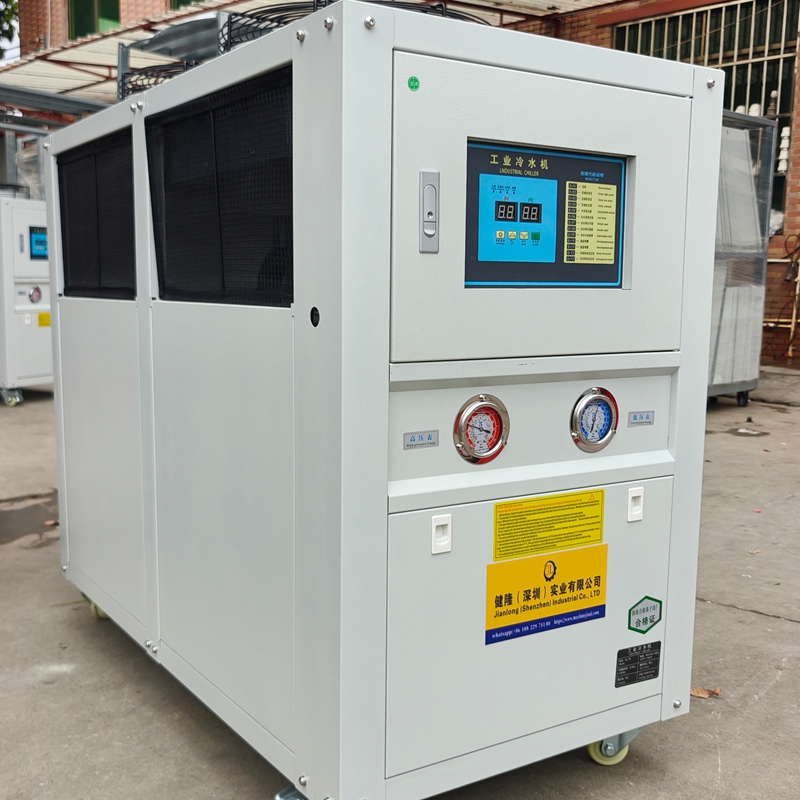
Whether it involves cooling carbonated beverages to 4°C prior to bottling, rapidly chilling milk during initial processing, or maintaining constant temperatures within fermentation rooms, industrial chillers serve as the "unsung heroes" working behind the scenes to ensure the efficient operation of the modern food industry. Are you primarily focused on cooling solutions for beverage bottling lines, or on temperature control requirements for specific food processing stages (such as meat products, sauces, or baked goods)? Please let us know your specific product type; we can assist you in accurately determining the necessary cooling capacity calculations and material specifications for your selection process. If you have procurement needs, require further consultation, or have specific requests, please contact us (you may also scan the WhatsApp QR code below). Jianlong Hydraulic Technology is dedicated to providing you with personalized, customized, and professional solutions, and we look forward to serving you.

Contact: jojo
Phone: +8618988729072
E-mail: lifuyan78@gmail.com
Whatsapp:8618988729072
Add: Guangdong Province, China TianHe District, GuangZhou Num 899